

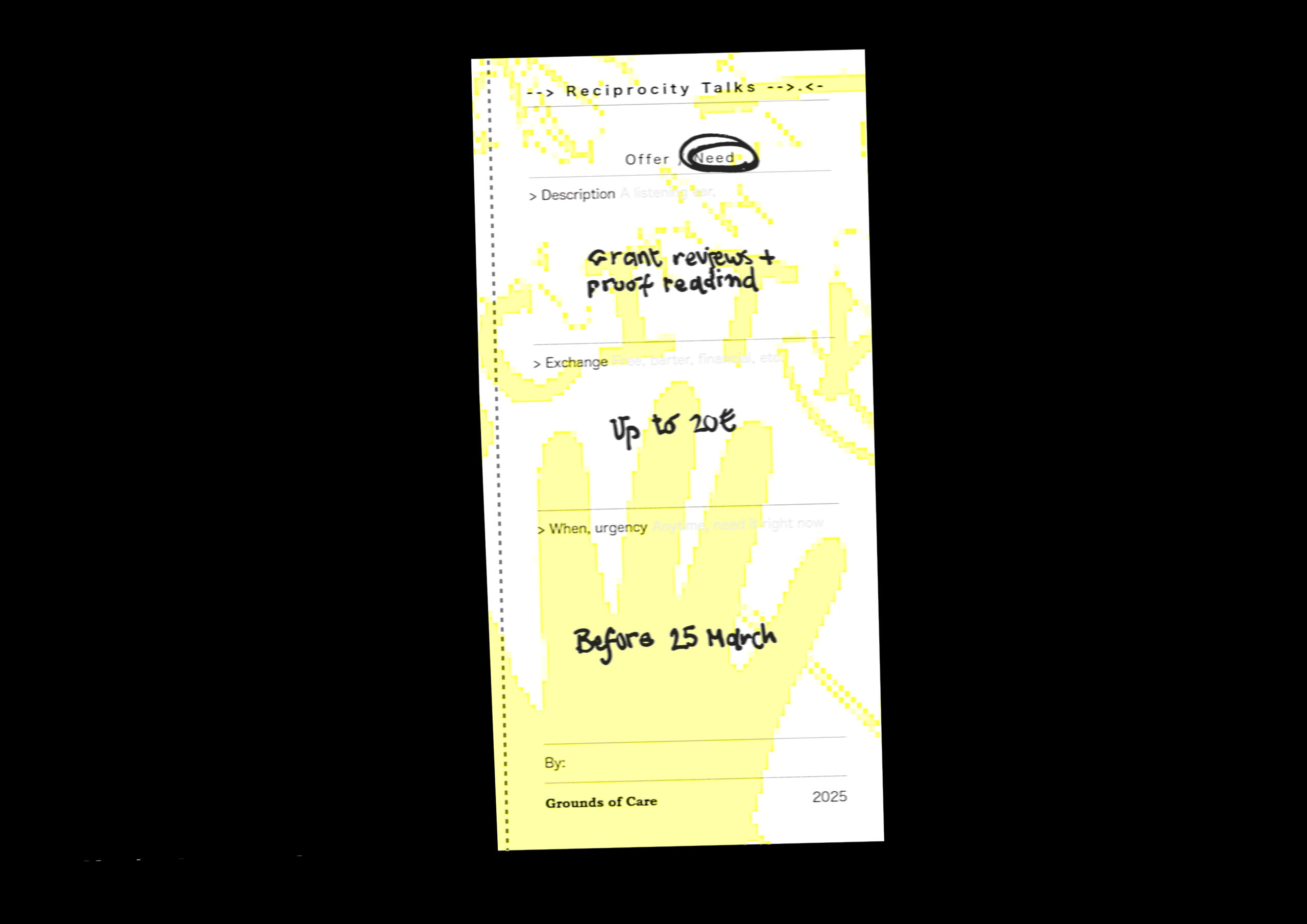
We often wonder, why don’t we engage in more direct exchanges with our direct communities? How come that it can be sometimes so difficult to realize only after the fact that a person you are close to may have been in a need that you could have provided help. It can be difficult to voice needs even in our closest environments. And it is also the case that an offer you could give is being undervalued or assumed. How can we legitimize community level services, while promoting them to happen? How can we allow for these conversations to happen more freely?
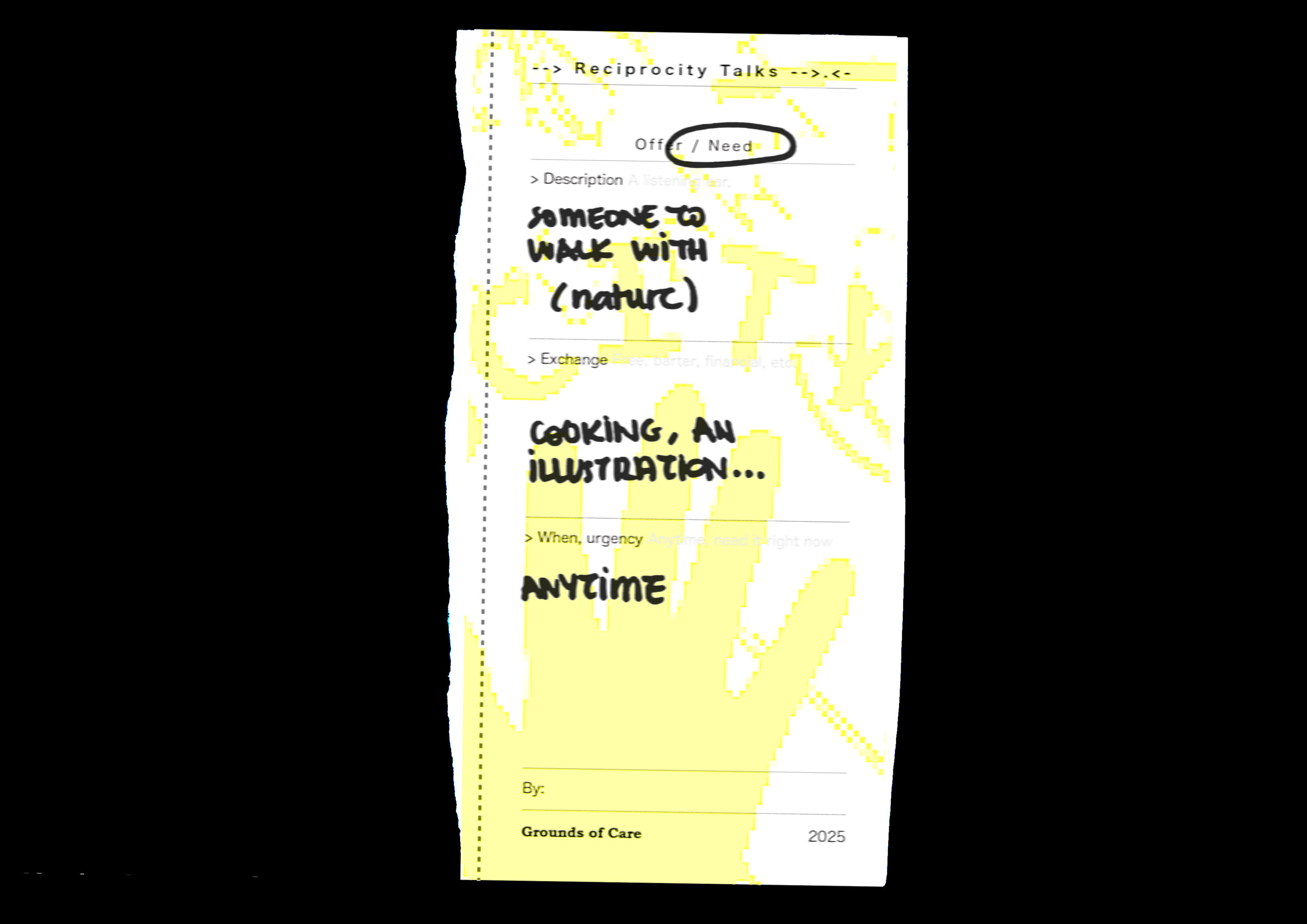
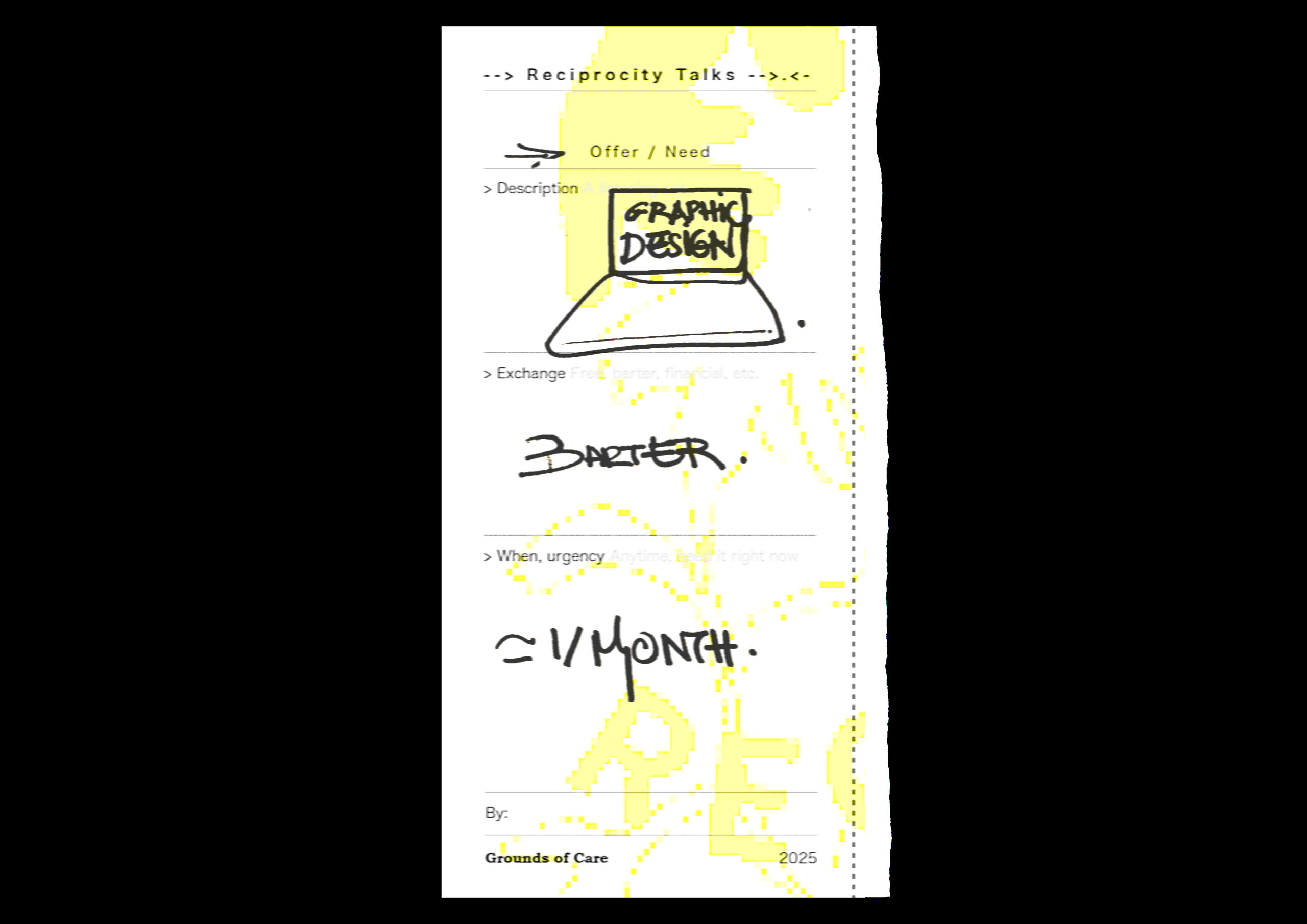
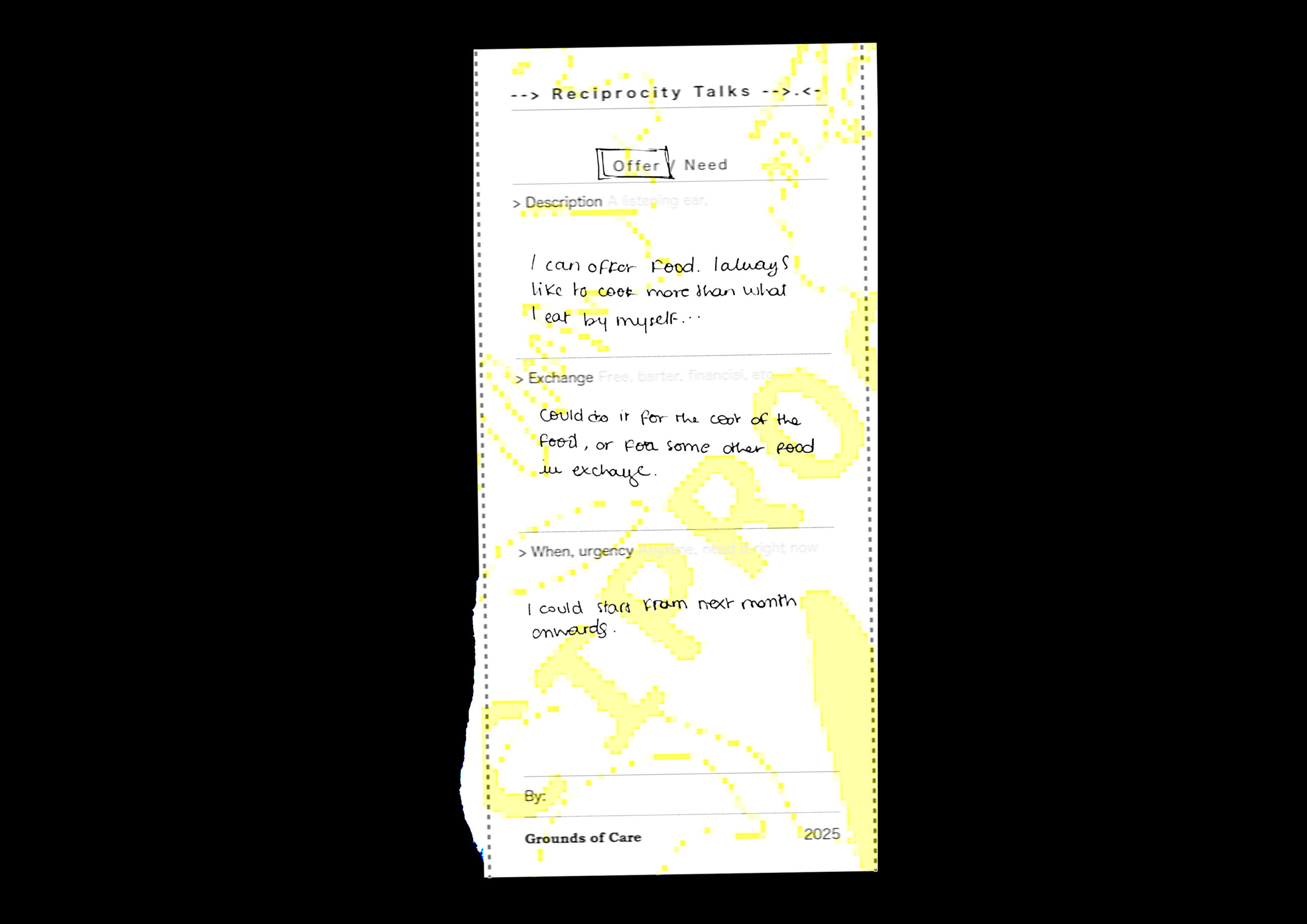
Reciprocity Talks explores how sharing needs and offers can be used to build community as well as engage in alternative local economies. Inspired on The Offer and Needs Market pioneered by the Institute of PostGrowth, we developed an approach that provides a setup for participants to exchange their needs as well as their offers. This allows participants to find the common grounds through which they could further help each other. It promotes exchange (which could range from free, to barter to financial) which do not rely on their commercialization.
SUPPORTED: Solidarity Workgroup Rotterdam
Reflection of a Reciprocity Talks session facilitated at Rotterdam’s Solidarity Group:
Offerings could be interpreted in multiple ways. One approach of “offerings” came from holding zero expectations for any exchange in return, with an attitude that the act of giving was fulfilling enough. Discovering that multiple people had the same offer (cooking/sharing excess food) presented new opportunities of creating something greater than the 1×1 exchange (Tupperclub, inviting cultural exchange beyond the necessity of feeding ourselves). By making our collective offerings visible in this exercise, we could identify how our respective strengths and weaknesses could build on another into a network that deeply serves us.
Defining “offerings” also came from a more intrinsic question of how each person defined the “work/labor” they are capable of. A deeper analysis of the different forms of labor would help us see how work is collectively defined and understood, particularly in terms of professionally recognized labor (skills that the market rewards monetarily) versus the often-overlooked ‘soft’ labor that, while undervalued by society, remains equally essential. By discussing and verbally sharing our individual contributions, we brought visibility to ‘soft’ labor, transforming how we understand and show up for each other.
The process of defining our offerings raised the question of how we each interpret and communicate this value of exchange. In reality, exchanging offers and needs beyond the commercial market does not provide escape from the real necessity to pay your bills to live and survive in a market economy, so how do you talk about money? The group recognized this is not a sole decision, but a dialogue between parties to recognize power dynamics (e.g., recognizing variable access to monetary/safety/or security privileges) and transparency about the true cost of what’s being exchanged (e.g., material costs). With clear context, you can find a fair transaction balancing “pay what you think it’s worth x pay what you can” (a nice example of this is through the boundaries of sliding scale payment systems).
Through offering, you may or may not expect something back. Whatever the form of currency is, this “barter” can be interpreted as “social debt” (see currency book example from japan (?)). The group recognized the power of such social debt, as the birth of every relationship. For example, falling down the stairs, someone helps you up. You might offer a coffee for their support. It takes a window of vulnerability to invite someone else to engage in a moment of support. But for whatever reason, some relationships fade and others grow. Urgency plays a key role in this dynamic. It creates the conditions for reciprocity, turning fleeting moments into potential bonds.
INITIATED BY: Alicia Ville, Crystal Mah